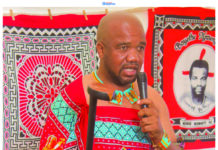



The High Court has dismissed a bail application by businessman Zweli Welile Dlamini, who is facing serious national security-related charges.
The court noted that his claim to dual citizenship posed a serious risk that he could evade trial and flee the country.
Dlamini is charged with one count under the Suppression of Terrorism Act, one count of contravening the Explosives Act of 1961, and further offences under the Arms and Ammunition Act of 1964.
According to the amended indictment filed before the court, the charges relate to alleged unlawful possession and involvement with prohibited weapons and explosives, offences regarded as a direct threat to public peace and security.
In his sworn application for release on bail, Dlamini told the court that he was a law-abiding citizen with strong family and business ties in both the kingdom and South Africa.
“I am an adult local citizen holding dual citizenship with South Africa. I reside at Mpolonjeni in the Mbabane area in the Hhohho district and also at Centurion, Pretoria, in the Republic of South Africa,” Dlamini stated in his founding affidavit.
He based his bail application on two grounds. Firstly, he relied on Article 16(7) of the Constitution, which provides that an accused was entitled to be released on bail on reasonable conditions unless there are compelling reasons to deny it.
Secondly, he raised what the court described as personal circumstances. Dlamini told the court that he was the sole breadwinner in his family and that he has two minor children aged nine and 12 who depend on him for support.
RELATED | PLAN TO DISRUPT INCWALA: Cops looking for 20 more suspects
He further stated that he was a businessman operating locally and in South Africa. His local business, WelzCollection trading as Combat Zone, is based in Mbabane. Dlamini also claimed that he was in poor health and that prison conditions were worsening his condition.
“I suffer from chronic sinusitis, a back problem, a persistent urinary tract condition and I have been diagnosed with a hernia. My health has deteriorated because I am not receiving adequate medical attention in custody,” he told the court.
However, the Crown had opposed his release, arguing that his freedom would endanger public safety and undermine national security.

The prosecutor submitted that if released, Dlamini could intimidate witnesses, conceal evidence or commit further offences. The Crown also argued that his alleged dual citizenship made him a serious flight risk. “The applicant may easily cross into South Africa and evade trial. His release would endanger public peace and security,” the Crown submitted.
In its ruling, the court stated that while an accused should not be detained merely to allow investigations to continue, Dlamini’s own admission of dual citizenship raised serious constitutional and practical concerns.
High Court Judge Justice Mavuso quoted the Constitution, noting that the country did not recognise dual citizenship.
“The red flag in this application is the applicant’s own claim to dual citizenship. The Constitution does not permit dual nationality and this has serious implications for the enforcement of bail conditions,” the judge said.
The court found that Dlamini would be able to post bail and immediately leave the country.
“Once he deposits bail, he will be free. If he then chooses not to attend trial, he could simply cross into South Africa within a short period, even using informal border crossings,” Justice Mavuso said.
Dlamini’s lawyer proposed strict bail conditions, including a high monetary deposit, regular reporting to the police and the surrender of both his local and South African identity documents.
CONTINUE TO READ | Woman (32) shot twice, killed by admirer (67)
The defence also argued that the country had an extradition treaty with South Africa.
However, the judge rejected these proposals. “Given the proximity of the kingdom and South Africa as well as the existence of informal crossings, these conditions are not sufficient to prevent the applicant from evading trial and relocating to South Africa where his businesses are situated,” Judge Mavuso ruled.
On the issue of extradition, the court said it would be failing in its duty if it allowed a situation where the applicant could first flee and only then be pursued.
“The court must prevent flight, not rely on extradition after the damage has been done,” the judge said.
Regarding Dlamini’s health concerns, the court held that arrangements could be made for him to be treated by his own specialists while in custody.
“For these reasons bail is denied, the application is dismissed,” the court ruled.


![Alpheous Mfana Nxumalo.[Illustrative Image]](https://eswatiniobserver.com/wp-content/uploads/2026/04/Money-In-The-Bag-218x150.jpg "Govt offers Alpheous E1.2m")