
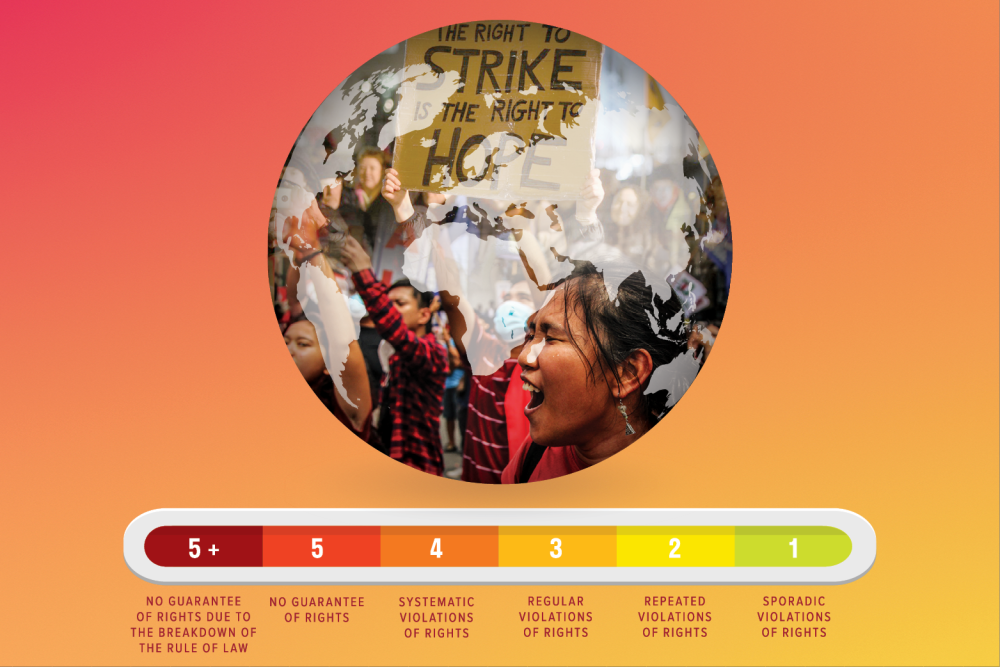
Eswatini has for the fourth consecutive year been ranked among the world’s 10 worst countries for workers by the International Trade Union Confederation (ITUC).
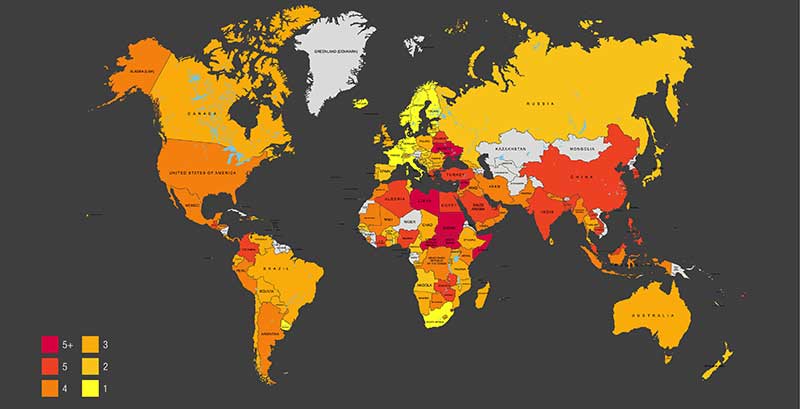
The Brussels-based global labour federation has released the 2025 Global Rights Index, placing Eswatini alongside Bangladesh, Belarus, Ecuador, Egypt, Myanmar, Nigeria, the Philippines, Tunisia and Türkiye as the countries where workers face the most severe and systematic violations of their rights globally.
The latest ranking in the annual index reinforces a pattern that has now become entrenched since 2022, where the country is at the bottom tier of the Index.
What is the ITUC?
The International Trade Union Confederation (ITUC) is the world’s largest global
labour organisation, representing more than 200 million workers through national
trade union centres in over 160 countries.
The country’s score is unchanged from last year, a sign, according to the report, that conditions for working people have stagnated or deteriorated rather than improved.
In its country assessment, the labour federation links labour rights concerns to broader political matters, claiming that while trade unions, which are vital democratic institutions, continue to face persecution.
Central to the ITUC’s assessment is the use of the Public Order Act of 2017 to restrict gatherings, protests and petition delivery.
“Basic freedoms of expression and peaceful assembly are severely restricted,” the Index stated, highlighting cases involving Swaziland Transport, Communication and Allied Workers Union (SWATCAWU) Secretary General Sticks Nkambule and Swaziland National Association of Teachers (SNAT) President Mbongwa Dlamini.
READ MORE | Teachers to be trained on competency-based education – PS
Their cases, according to ITUC, reflect a wider pattern of alleged harassment, intimidation and victimisation of union leaders, claiming that they are not isolated incidents, but part of a systematic effort to weaken organised labour.
“While the Constitution formally guarantees freedom of association and recognises the rights to collective bargaining and strike action, these rights are hollowed out by restrictive legislation and administrative control,” argued the federation.
It further points out policy issues it sees as playing a role in suppressing workers’ rights.
The federation started off by pointing out that under the Industrial Relations Act, the commissioner of labour has wide discretion over the registration of trade unions and may demand extensive information in support of applications.
“The law also imposes detailed requirements on union Constitutions, including mandatory annual general meetings and limitations on who may vote, restricting participation to fully paid-up members only,” read a part of the report.
“Certain categories of workers face outright exclusion. Workers in export processing zones (EPZs), for example, are not permitted to form or join trade unions,” read another part of the report, highlighting that this restriction directly undermines international labour standards.
The ITUC further claims that collective bargaining, though recognised in law, is also constrained.
If a union represents less than 50% of workers in a bargaining unit, recognition for bargaining purposes is left to the discretion of the employer, a provision the ITUC describes as an undue barrier that weakens unions’ negotiating power.
The report further calls attention to the fact that the right to strike is one of the most tightly regulated aspects of labour law in the country.
According to the Index, strikes are permitted only in the context of unresolved disputes, effectively banning sympathy and solidarity strikes.
Why is Eswatini ranked poorly?
According to the ITUC, Eswatini’s ranking reflects concerns over restrictive
labour laws, limitations on the right to strike, constraints on trade union
activity and the use of public order legislation to limit protests and assembly.
“Protest action, meanwhile, requires 21 days’ advance notice and cannot be purely political in nature. Before a strike can proceed, a secret ballot overseen by the commissioner of labour must show that a majority of all employees, not just those voting, support the action,” read another part of the report, adding that even after a successful ballot, unions must observe further notice periods, adding layers of delay and uncertainty.
The report also mentions the minister of labour is empowered to seek a court declaration that a strike is illegal if it is deemed to threaten the national interest, while disputes in essential services can be referred unilaterally to compulsory arbitration.
The list of essential services is described by the ITUC as excessively broad, including sectors such as telecommunications and sanitary services.
In addition, the report highlights that trade unionists remain liable under civil and criminal law for damages arising from protest action and employers are permitted to use replacement labour during lawful strikes.
The ITUC states that the Industrial Court of Appeal upheld this principle in 2017, despite calls from the ILO Committee of Experts for legislative reform to protect striking workers.
Africa as a whole recorded its second-worst score on record in the 2025 Index, deteriorating to 3.95 from 3.88 in 2024.
According to the ITUC, workers’ rights to strike, collective bargaining and union membership were impeded in 90% of African countries.
The report highlights that the vast majority of workers on the continent are employed in the informal sector, where labour protections are minimal or non-existent.
In 93% of African countries, the rights to strike, bargain collectively and form or join a union were violated.
Nigeria entered the list of the world’s 10 worst countries for workers for the first time this year, while the kingdom’s continued inclusion underscores what the ITUC describes as “systematic and entrenched repression” of trade union activity in several countries.
The Index also documents violent suppression of strikes and protests in countries including Kenya, Cameroon, Mauritania and South Africa, while union activists were killed in Cameroon and South Africa.
The 10 worst countries for workers in 2025 (ITUC Global Rights Index):
1. Bangladesh
2. Belarus
3. Ecuador
4. Egypt
5. Eswatini
6. Myanmar
7. Nigeria
8. The Philippines
9. Tunisia
10. Türkiye