


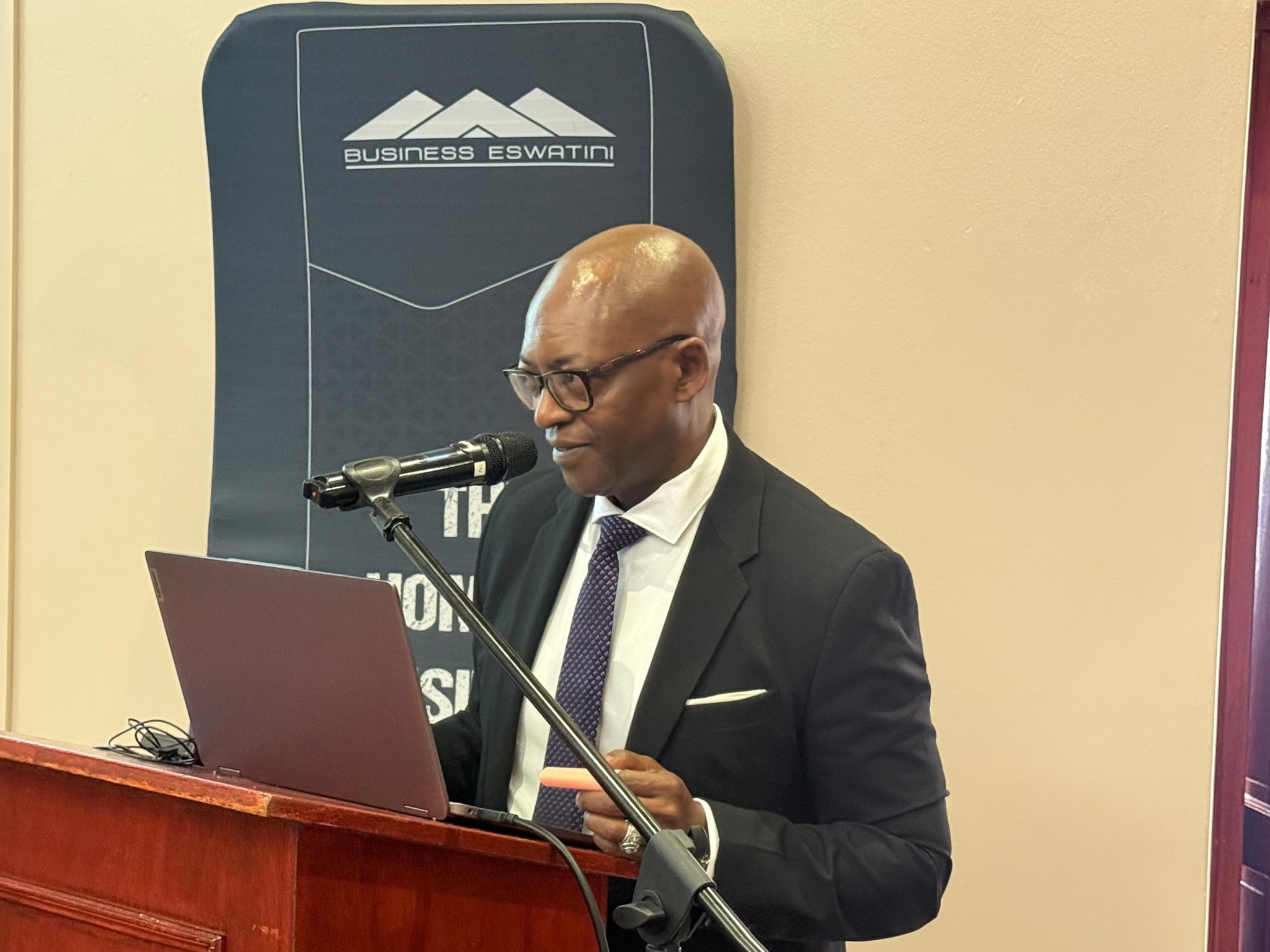
Business Eswatini Chief Executive Officer (CEO) E. Nathi Dlamini has weighed in on the on-going national debate on the taxation of churches, saying that those earning income through church employment must comply with the country’s tax laws.
Quoting the biblical verse Matthew 22:21, which says “Render unto Caesar the things that belong to Caesar and to God the things that are God’s,” Dlamini said the scripture reinforces the principle of lawful compliance.
Eswatini Observer WhatsApp Channel
“I think it is only fair to say they, too, have to pay tax like the rest of the citizens,” he said, referring to individuals who receive salaries or other forms of income from church resources.
However, he clarified that funds received by churches for evangelism, community outreach or charitable projects should not be taxed. “Many churches in this country do a lot of good and we should not make it difficult for them to carry out God’s mandate,” he said, citing church-run orphanages, schools, and clinics as examples.
Dlamini added that he was less concerned with how a church is registered, whether as a non-profit or a company, as long as it complies with national laws. “If there is any suspected abuse, then the Eswatini Revenue Service (ERS) should intervene,” he said.
League of African Churches President Bishop Samson Hlatjwako echoed similar sentiments, saying the church fraternity is awaiting engagement with ERS on the issue. “Some churches are registered as businesses and those must pay tax if that is what is expected of them,” he said.
But he hoped that government would tread carefully on this matter lest the church fraternity become discouraged in playing their role in society. He said if a church has indeed hired people to even sweep the premises then the tax laws might have to be applied. The bishop also believed that this matter will be extensively debated even in parliament when time comes and the church fraternity looks forward to such.
RELATED: Government to develop database for churches
Economist Sanele Sibiya noted that if a church is registered as a proprietary and uses Form C, then it is a company disguised as a church after all. He said whether it is registered as a company or a non-profit entity it still has to adhere to Eswatini Revenue Service (ERS) rules. He added that it would be wrong to turn the matter of taxation into a spiritual debate.
“Some churches operate like businesses and even sell merchandise to make revenue, which distinguished them from being a charitable entity.
The subject of taxation of churches is one that has caused public debate. During a media session at the launch of the 2025 Income Filing Season and Compliance Improvement Plan recently.
Meanwhile, Minister of Finance Neal Rijkenberg recently clarified that government had no plans to tax churches but will intensify efforts to combat tax evasion and financial abuse disguised under religion.
He emphasised that the focus is not on taxing faith-based groups but on ensuring compliance and financial transparency when religious entities are used for personal or commercial gain.
Churches in Eswatini remain tax-exempt under the Income Tax Order of 1975, though any personal income earned by individuals through church activities—such as salaries or specific offerings—remains taxable.
Eswatini Observer Press Reader | View Here



![Alpheous Mfana Nxumalo.[Illustrative Image]](https://eswatiniobserver.com/wp-content/uploads/2026/04/Money-In-The-Bag-218x150.jpg "Govt offers Alpheous E1.2m")