
As the World Press Freedom Day approached, I found myself seated inside the European Commission’s mid-day press briefing room at the Berlaymont building in Brussels, watching journalists openly question officials on issues ranging from Russia and Moldova to the withdrawal of funding linked to the Venice Biennale.
The openness of the exchange was what particularly struck me. Officials answered in real time, journalists pushed back where necessary, and the engagement unfolded with a level of transparency that immediately felt unfamiliar coming from my country.
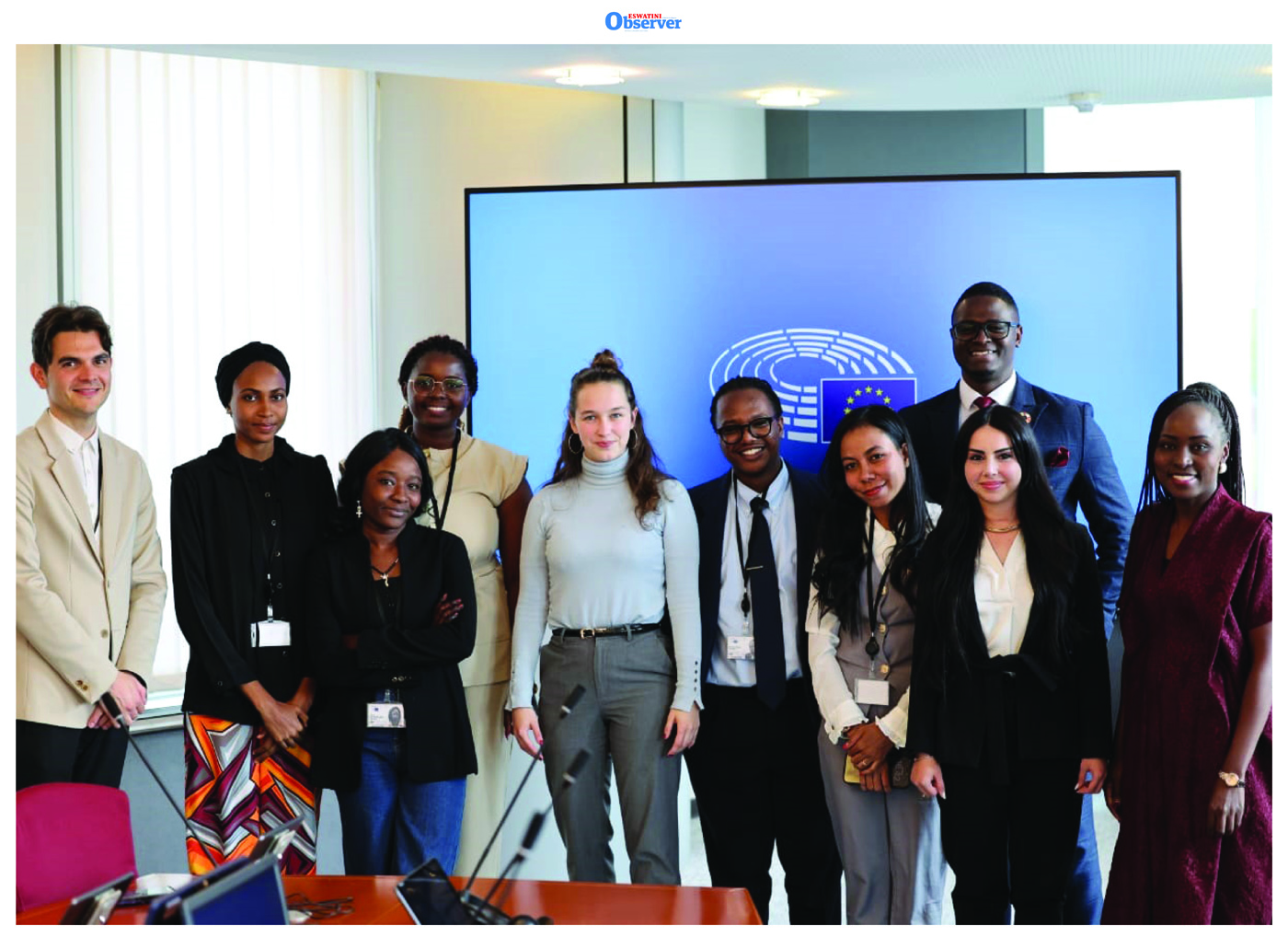
I had travelled to Brussels last month under the European Union Visitors Programme (EUVP), joining eight other young professionals from across the world as the European Union Delegation (EUD) in Eswatini prepared to commemorate 50 years of partnership with the Kingdom.
The initiative is designed to expose emerging leaders to the EU’s institutions, decision-making processes and evolving policy priorities.
For a week, I moved between the European Parliament, the European Commission and the European External Action Service (EEAS), stepping into the spaces where Europe debates policy, negotiates competing interests and shapes its engagement with the rest of the world.
Along the way, we engaged with parliamentarians, communication strategists and youth participation experts. Beneath the bureaucracy that defines much of the EU, I encountered institutions actively reassessing Europe’s place in a rapidly changing world, including its relationship with countries such as Eswatini.
Although I travelled to Brussels already somewhat familiar with the European Union through my role as a member of Eswatini’s inaugural EU Youth Advisory Board, the EUVP offered something far more practical. It provided a clearer view into how decisions are negotiated, the constant balancing of competing national interests, and how the EU attempts to uphold the democratic values it prides itself on amid growing geopolitical pressure and uncertainty.
READ MORE | Eswatini, EU celebrate 50-year partnership
It was difficult to ignore the pressures weighing on the bloc itself. The Russia-Ukraine conflict, rising nationalism, economic uncertainty and intensifying geopolitical competition have all forced Europe to reassess not only its place in the world, but also how it projects influence beyond its borders. Watching how Europe wrestles publicly with its own contradictions prompted reflection on Africa’s institutions and the extent to which openness itself shapes public trust.
One discussion in particular stayed with me. Listening to how the Union evolved from a project initially centred on economic cooperation into a broader political and institutional union inevitably raised questions about Africa’s own regional bodies. The Southern African Customs Union (SACU) remains the world’s oldest customs union, yet its evolution has largely stalled over the years, while the African Union still struggles with establishing itself as a cohesive and influential continental force.
Of course, Europe’s integration story and Africa’s are fundamentally different, and perhaps that is what continues to make relations between Africa and Europe uneasy at times. Africa’s political and economic fragmentation did not emerge naturally, it was shaped heavily by that fateful meeting in Berlin which resulted in decades of resource exploitation, much of it carried out by the very countries that today speak the language of partnership and cooperation.
It was encouraging, therefore, that many officials within EU institutions appeared conscious of this history and aware that partnerships with African countries cannot succeed if they are perceived as paternalistic or prescriptive. Throughout the visit, there was a noticeable effort to frame cooperation around partnership, mutual respect and shared interests rather than instruction.

That matters for EU-Africa relations. It matters for Eswatini too, because we are a country that takes pride in its home-grown system of governance and its right to shape its own political path. Partnerships are often strongest when friends engage constructively within the realities and philosophies that societies define for themselves, rather than approaching cooperation through the expectation that progress must always mirror external models of ‘democracy’.
The EU is the kingdom’s largest development partner and as both sides commemorate 50 years of relations, understanding the values, systems and governance culture shaping the bloc becomes increasingly important. Relationships of this nature should also create space for learning from one another.
And for me, the clearest lesson from Brussels emerged not from policy discussions, but from the relationship between governance and accountability. Accountability, or perhaps, the attitude towards it, appeared embedded within the institutional culture itself. Public officials seemed to operate with the understanding that scrutiny is part of governance, not an inconvenience to it.
Here at home, however, that culture remains far less developed and, in many respects, appears to have regressed in recent years.
A few years ago, government introduced communication officers across ministries, a move many journalists initially welcomed because it appeared to signal a shift towards openness and easier access to information. There was genuine optimism that the initiative could help narrow the distance between government, the media and citizens.
Instead, the initiative has largely fallen short of those expectations. In many ministries, communication officers operate with limited access to meaningful information, while their effectiveness often depends on their relationship with the minister leading the portfolio at the time. Rather than becoming genuine bridges between government and the public, many have gradually been reduced to managing social media pages, coordinating publicity and taking pictures at events.
The access to information challenge is further complicated by the continued existence of laws such as the Official Secrets Act of 1968. While every government has legitimate national security interests to protect, the broad nature of the law continues to restrict access to public information, often making it difficult for journalists to effectively fulfil their watchdog role.
In that environment, Prime Minister Russell Dlamini’s decision to halt engagement with the Editors’ Forum following stinging criticism from The Nation magazine editor Bheki Makhubu further weakened an already fragile culture of institutional openness between Cabinet and the media.
ALSO READ | Eswatini expands sugar export markets
Since then, the promised press conferences have largely remained exactly that, promises, while journalists continue fighting for access to information at a time when tensions within the executive increasingly spill into Parliament and public view.
The danger with restricted access to information is that it creates fertile ground for mistrust, fuels disinformation campaigns and becomes a breeding ground for corruption itself. When public institutions become difficult to scrutinise, accountability weakens, public confidence steadily erodes and governance begins to appear increasingly opaque to ordinary citizens.
In this country, that erosion of trust has unfolded alongside growing public concern over corruption and visible instability within key state institutions, including the judiciary, deepening perceptions of a system struggling to reassure citizens that it remains transparent, accountable and functioning effectively.
That crisis of confidence is reflected in the 2025 Corruption Perceptions Index released by Transparency International, where Eswatini ranked 153rd out of 182 countries globally alongside Lebanon, Iran and the Republic of the Congo.
The EU’s openness to engagement also extended beyond media engagement into questions of political participation itself. One of the most memorable engagements of the week was meeting Lena Schilling, the 25-year-old currently serving as the youngest Member of the European Parliament.
Coming from a country where young people rarely occupy influential political positions, it was genuinely inspiring to see someone so young operating confidently inside one of the world’s most influential political institutions. What stood out was not simply her age or energy, but the seriousness with which she approached political responsibility.
She spoke candidly about the pressures of being young in politics, but also about the importance of patience, collaboration and learning from those already inside the system. What made the engagement particularly impactful was seeing a youngster that had transitioned from activism into government without losing the values that brought her there in the first place.

The conversations around strategic communication and disinformation were equally significant. Officials from the EEAS working on Sub-Saharan Africa spoke about the growing challenge posed by misinformation and how the EU attempts to respond through coordinated communication and information integrity strategies. For someone working in media on the African continent, those conversations felt immediately relevant. They emphasised the importance of verification, context and evidence-based reporting in an era where misinformation often travels faster than facts.
Perhaps the most hopeful part of the visit came during the European Youth Week plenary session, where young people from across Europe gathered to deliberate on issues ranging from governance and democracy to climate change and participation.
What stood out was the intentionality behind it all. Europe is confronting an ageing population, yet its institutions remain deliberate about integrating youth voices into governance and policymaking.
That is something many African countries, including this country, can learn from. Eswatini has one of the youngest populations in the world, while Africa itself remains the world’s youngest continent, yet young people are still largely excluded from meaningful decision-making despite representing the demographic majority.
When I boarded my flight back home, I carried more than institutional knowledge. I left Brussels reflecting on how societies build trust in public institutions and how quickly that trust begins to erode when access to information narrows, accountability weakens and young people remain excluded from power. Europe itself is confronting difficult questions around migration, inequality, political polarisation and the legacy of its own history.
Yet despite those pressures, its institutions continue to place themselves before the public and the media in ways that invite scrutiny rather than avoid it.
For a journalist coming from a country where public accountability and institutional openness are almost non-existent, that may have been the most important lesson of the entire visit.