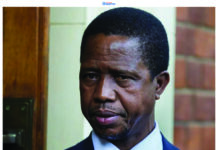



Minister of Finance Neal Rijkenberg has projected collecting E2.5 billion in tax in the coming financial year.
The minister pointed to strong gross domestic product (GDP) growth of 5.6% last year, while the country relies heavily on the Southern African Customs Union (SACU) revenue. The deficit is at 4.9% of GDP, the minister said, describing it as a move from stability to acceleration.
He noted that the economy was also growing, tax revenue increasing, and that the country could take more debt because it is on a sustainable growth path. He said next year, the country would collect E2.5 billion more tax than this year, opening more space to grow the economy.
Notably, this year the Eswatini Revenue Service (ERS) collected E14.6 billion, exceeding the target. An estimated additional E2.5 billion would mean that ERS would collect E17.1 billion.
The minister further explained that the contributing factors towards the projected increase were mainly the fiscalisation plans of ERS and closing the value added tax (VAT) gaps. He emphasised that the projection was neither based on SACU receipts nor increased taxes.
He noted that a big portion of the budget went to the salary review exercise, which he said was necessary and critical. He said the capital budget also increased to ensure that the growth trajectory remained on track.
ALSO READ | Comply with income tax certificate regulations – Finance minister
Rijkenberg further noted that the World Bank, through the International Development Association (IDA) funding, was concessional debt which assists the country to grow the economy, and the repayment was less than what other commercial funders charge.
He noted that government introduced two contingent liabilities, whereby, even though the country is taking the liability as government, it would not be repaid by government but by another entity. He cited the E5.2 billion strategic oil reserve implemented by the Eswatini National Petroleum Company (ENPC) that will repay every cent, stating that taxpayers will not pay the loan.
Strategic Fuel Reserve Initiative
The strategic fuel reserve initiative aims to strengthen the country’s energy security by establishing storage facilities capable of maintaining sufficient petroleum supplies during regional or global disruptions. ENPC is a state-owned entity responsible for managing the country’s petroleum supply and strategic fuel reserves. The project is being financed by the Taiwan Export-Import Bank.
He said the repayment method will rely on operational revenue generated by the entity through the fuel storage system, as well as sales made from fuel levy. By constructing the oil reserve, the country aims to reduce its vulnerability to external shocks and reliance, while ensuring that critical sectors such as transport, agriculture, and industry continue to operate during periods of instability.
The debt-to-GDP ratio remains at 43%, which must be maintained.
“This has been a tough year for two reasons; our interest payments are shooting up even though we are taking up more debt — one of the lowest countries with that debt-to-GDP ratio — and the International Monetary Fund (IMF) is being paid. We are doing many things right, but the interest rate is still hurting because it grew by almost E1 billion last year.
“The second one is the E2.5 billion for the salary review exercise. Between those two, it ate up a majority of the space.
“We had to add something to growth to make sure that we do not lose the momentum we are gaining,” said Rijkenberg.