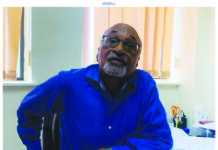



The Masilela couple in Nkomazi is deeply worried about the future and safety of their seven children with albinism.
Some of the children have already lost job opportunities due to their condition, while others, who are still in school, struggle academically as they lack learning aids such as reading glasses.
| Eswatini Observer WhatsApp Channel
With the hot summer days soon approaching, the couple also has to provide enough protective clothing, hats and sunscreen to shield their children’s sensitive skin, this may prove to be a difficult case since, they are both unemployed.
Albinism is a genetic disorder in which the body produces little to no melanin, the pigment that gives colour to the skin, hair and eyes. This results in very pale skin and hair, as well as significant vision problems such as light sensitivity, involuntary eye movements and blurred vision. While there is no cure, management includes sun protection, vision aids, and regular eye examinations to prevent sunburn, reduce the risk of skin cancer, and maximise vision.
For Thembi and Sikelela, married for 40 years, this is the most anxious period of their lives. They dream of a better future for their children, one where albinism does not become a stumbling block that traps them in poverty. They also hope to protect them from skin cancers and other health complications commonly associated with the condition.

The couple lives with another constant fear: when their older children fail to return home immediately after sunset. This fear is not unfounded. Across parts of Africa, an abhorrent witchcraft belief persists – that killing a person with albinism and using their body parts for muti can bring wealth and success. This dangerous myth has made people with albinism targets of violence and exploitation.
Though a majority of the couple’s children have albinism, four were born without the condition. Thembi and Sikelela have raised them all with equal care and love.
Thembi (57) takes pride in the fact that with her husband and their faith in God, they have managed to shoulder this extraordinary journey together. Speaking to the Sunday Observer, she said she got married to Sikelela in 1985 and they built their home in the Nhlalakahle community under Nkomazi Inkhundla.
“In three years’ time (1988), we had our first child and all was normal. When our second-born arrived, he had albinism, much to our shock. After a while, we accepted what God had blessed us with, hence we named him ‘Sibusiso’. Our third-born also came into this world with the same condition,” explained Thembi.
By then, the couple had braced themselves for the likelihood of having more children with albinism. They realised that both their gene pools carried the condition. Thembi’s relatives had albinism and it was the same case for her husband’s family.
Later, it was explained to them that their genetic backgrounds gave them a high chance of having children with albinism. As difficult as it was at first to face this reality, they chose to embrace it.
“We didn’t see it as witchcraft or a curse. I grew up playing with some of my relatives who had the condition and so did my husband. But I had no knowledge of how to care for someone with albinism. I would go out and work in the sun with my baby on my back. By the end of the day, the baby would cry endlessly and suffer severe sunburns, as if scalded by hot water,” she recalled.
Thembi eventually corrected her mistakes after visiting a clinic, where she was educated about the proper care of children with albinism.
Their fourth child turned out to be without the condition, which by then they understood was a 50/50 chance. Their fifth and sixth children were also born without albinism. In their eyes, all their children were the same and none was given special treatment.
The next three children (including a grandchild), however, were all born with albinism. They adopted an attitude of gratitude, no matter what and this helped them cope.
“I was never at any point ashamed of my children. I knew better to carry an umbrella when going out in the sun, to dress the children appropriately and to protect their skin from scorching rays. We couldn’t afford sunscreen at first, but things improved when government began providing it through hospitals,” she said.
Asked about her advice to young parents of children with albinism, she said they must never blame themselves or see it as a curse. They must understand that it is a genetic condition and their children were equally deserving of love and attention as any others.
One major challenge the couple still faces, is not being able to afford reading glasses for their children, which has compromised their academic performance. Thembi recalled that a few years ago, former senator Walter Bennett donated tablets to assist with reading. Their performance improved, but the devices eventually broke.
“Their eyes are sensitive to the chalk. They end up not taking notes properly and are left behind academically. At present, we need three reading glasses and seven sunglasses to protect their eyes. Reading is a struggle. They have to hold their books close to their eyes; it’s uncomfortable,” explained Thembi.
Despite the hardships of raising seven children with albinism, both Thembi and Sikelela still have big dreams for their future. However, as their older children continue to struggle with unemployment and sometimes stigma, those dreams feel increasingly far-fetched. Thembi has appealed to members of the public for assistance in any way possible by calling 7637 1058 or 7979 5447.
Son turned down for job
One of the sons of Thembi and Sikelela was turned down by a construction company solely because of his albinism.
Thembi revealed that her son, who completed school two years ago, had been struggling to find employment when a well-known local construction company contracted for a project in the Hhohho region offered opportunities.
“Like most young men in the community, he joined the queue with hope that he might get hired. But what happened was that he was called out from the line and told by an official that he stood no chance. He said, this was because of his condition, which would not allow him to work in the sun all day,” she explained.
He walked away dejected and depressed, realising that his condition could become a huge limiting factor in his life. Yet he refused to give up. With youthful determination, he started a vegetable garden to make a living.
It showed early promise, but water scarcity soon made it difficult to sustain. Thembi said the family urgently needs a water tank to harvest rainwater for gardening.
“A tank would change our lives because we can go big in gardening as a family. We are not a family that shies away from hard work,” she said.
Presently, Thembi and her husband survive by doing some piece-jobs in the community, but that is not enough. These days, the family relies on one of their daughters who partnered with a friend to start a sewing business.
One of their elder sons works at a hotel. “We try to combine our incomes, but it is not enough for the entire family,” she added.
Their daughter, Nqobile (28), appealed for assistance with a sewing machine that could expand her small tailoring business. She said such support would allow her to generate more income for her family and empower her to help her siblings.
“A sewing machine would really make a difference. It would help me take on more work and contribute towards the household,” she added.
Nqobile can be reached at 7662 7835.
Eswatini Observer Press Reader | View Here