
In small markets, leadership means more than having the largest subscriber base—it means deciding when to compete and when to cooperate to grow the market and boost the economy.
That is the posture adopted by MTN Eswatini: aggressive where customer value is decided, collaborative where scale, coverage, and national development are at stake. Sustainable growth is not built through indiscriminate or adversarial attacks. The result is a deliberate strategy of coopetition—competing for customers while partnering to accelerate digital access, skills, and services across the kingdom. Eswatini is the beneficiary.
This approach spans mature industries, fostering growth without value destruction. Examples include:
-
Samsung supplying Apple components amid smartphone rivalry.
-
Star Alliance uniting competing airlines to share routes, lounges, and loyalty programs.
-
Coca-Cola and PepsiCo partnering on recycling and sustainability.
-
Google and Microsoft competing in cloud/AI but aligning on open-source standards and cybersecurity.
The pattern: compete on differentiation, cooperate for shared scale and efficiency.
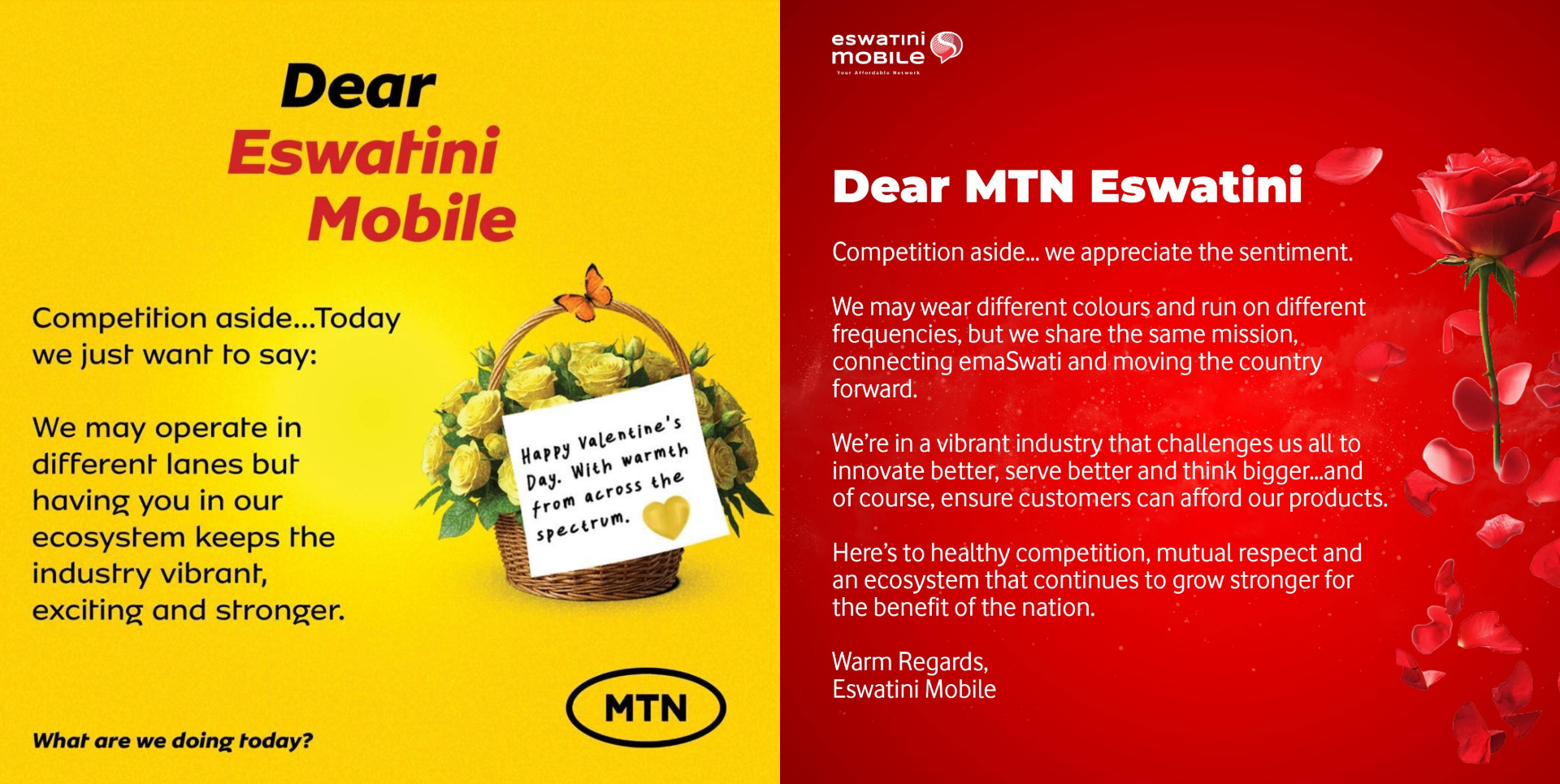
MTN Eswatini’s Bold Valentine’s Gesture: Cooperative Spirit
MTN Eswatini surprised consumers on Valentine’s Day by promoting collaboration over rivalry to address national challenges and enhance user value. The gesture involved publicly acknowledging Eswatini Mobile, followed by a CEO-to-CEO visit with a bouquet of Y’ello Flowers. This symbolic act introduced MTN Eswatini’s story and anchored it within a broader narrative of collaboration.
Similar gestures are observed across Africa:
-
In Uganda, MTN’s playful Valentine’s post with Airtel sparked a public, good-natured exchange.
-
In Nigeria (2023), MTN’s Valentine’s greeting to Airtel prompted warm online conversation, highlighting coopetition as a growing continental trend.
Strategic Collaboration and National Impact
MTN Eswatini’s leadership approach is built on strategic collaboration, operational excellence, and customer-centric differentiation. By owning and sharing digital infrastructure, MTN enables faster, lower-cost rollouts, strengthens coverage, and avoids duplicative capex while continuing to compete on experience and services.
Locally, MTN aligns teams and partners around a shared roadmap, using roadshows and public engagement to reinforce executional clarity, visible leadership, and competition focused on meaningful customer outcomes.
ALSO READ | Alleged kingpin identified in 85 foreign nationals bust
MTN Eswatini converts strategic intent into tangible programmes that advance digital literacy, expand access, and support local entrepreneurship. Initiatives such as the MTN Skills Academy and investments in ICT Labs strengthen the national talent pipeline, providing hands-on exposure to modern digital tools and supporting digitalisation across public and private sectors—directly aligning with Eswatini’s digital transformation agenda.
Beyond skills development, MTN Eswatini’s investments in digital inclusion and fintech strengthen the economy’s digital foundations, aligning with MTN Group’s purpose of “Leading digital solutions for Africa’s progress.”
With nationwide coverage, expanded fintech reach, and active network-sharing arrangements, MTN improves connectivity across rural and urban communities while enabling coopetition that prioritises national development over duplicative competition. These efforts demonstrate how accelerated digital transformation can unlock jobs, productivity, and resilience, especially in smaller developing markets.
Under the stewardship of Acting CEO Jerry Soko, MTN Eswatini balances commercial ambition with national digital priorities. The result is an approach where MTN competes assertively while cooperating on infrastructure, digital inclusion, and ecosystem growth—reflecting a leadership culture defined by execution, partnership, and long-term sustainability.