



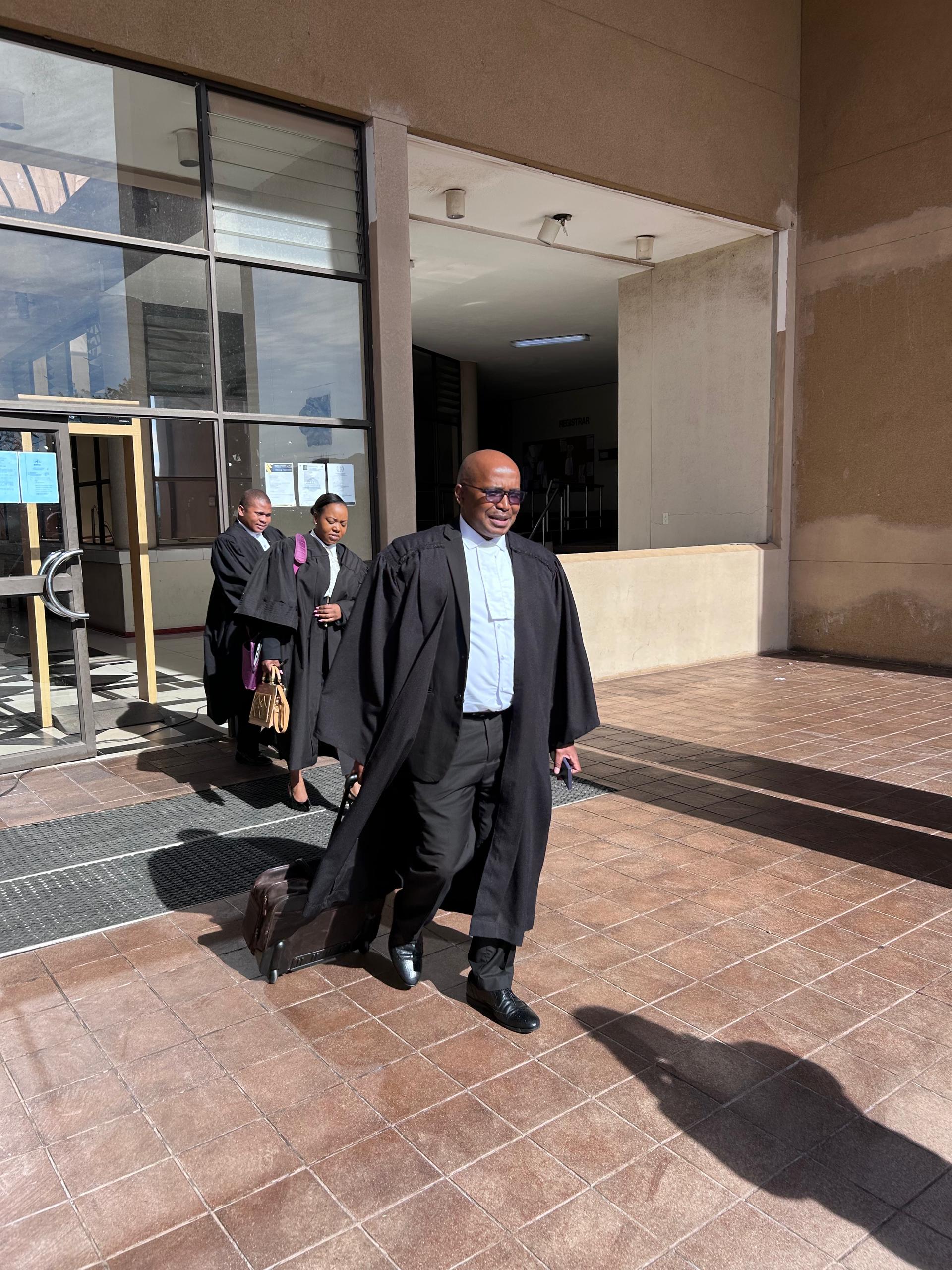
Government has expressed interest in the ongoing legal wrangle over share ownership between prominent businessman Michelo Shakantu and the estate of the late football mogul Victor Mfana Gamedze.
Government warned that unless stamp duties on the disputed E124 million share transaction are settled, the agreement should not be admitted as evidence in court.
This twist emerged in the High Court yesterday as Judge John Magagula presided over an urgent application filed by Shakantu and his company, Cherrybite (Proprietary) Limited.
They are seeking a spoliation order for the restoration of Cherrybite as the holder of 1 000 ordinary shares in Stage 1 Connections (Pty) Limited. They also want Shakantu reinstated as the sole director of the company.
At the heart of the applicants’ case in respect of Cherrybite’s claim is the contention by the applicants that the Share Transfer Agreement prohibits the unilateral cancellation of the agreement and that lawyer Derrick Ndo Jele was required to submit the matter to arbitration for determination.
The late Gamedze held shares at Eswatini Mobile through his company, Stage 1 Connections (Pty) Ltd.
The deceased businessman, according to the court papers, was a sole shareholder of Stage 1 Connections (Pty) Ltd. He held 1 000 shares.
The matter took a surprising turn when Assistant Attorney General Mbuso Simelane, appearing as an interested party on behalf of government, raised concerns about unpaid stamp duty amounting to E4 million, a statutory obligation under the Stamp Duties Act of 1970.
“There is an issue of whether that transfer of shares can be part of evidence before this court,” Simelane submitted. He argued that unless the requisite stamp duty is paid, the Share Transfer Agreement underpinning the dispute could not be legally admitted into evidence. He cited Section 13 of the Act, which provides that any instrument required to be stamped “shall not be produced or be given in evidence or be made available in any court of law” unless it is duly stamped.
“If the matter goes further, government will take issue that there is a sum of about E4 million that has not been paid,” Simelane submitted. “The transfer of shares agreement cannot be part of evidence before any court unless that duty is settled.”
He clarified that government’s interest in the matter was not rooted in the merits of the commercial dispute itself, but in the legal obligations arising from the alleged transaction.
“There is a Stamp Duties Act of 1970 which defines what a share is in Section 3. We are lucky that on the bench today are notaries and conveyancers who understand these implications,” Simelane submitted.
He emphasised that the matter is not about disrupting the hearing, but rather to ensure that due process is followed if the matter proceeds any further.
According to the parties’ submissions, the contested shares are valued at E124 million.
However, Simelane pointed out that this valuation is only gleaned from the affidavits submitted by both sides, as no pricing detail appears in the actual agreement tendered.
“So Your Lordship, what drew my attention to the Stamp Duty Act was the argument by my learned friends that there was a sale of shares. If you go into their affidavits, you will see that the transaction was around E124 million, but there is no specific price on the document,” said Simelane.
He warned that admitting an unstamped document into evidence would contravene established legal procedures.
He submitted that Section 13 of the Act does provide a pathway for such a document to be considered: “The court before which any such instrument is tendered may permit or direct that, subject to the payment of any penalty incurred in respect of such instrument… it is stamped in accordance with this Act, and upon the instrument being duly stamped may be admitted in evidence,” Simelane quoted.
He suggested that before judgment is delivered, the applicant should consider settling the stamp duty as part of regularising the document
On the other side of the aisle, Jele, the executor of Gamedze’s estate and the first respondent in the matter, questioned both the urgency of the application and its legal foundation.
Jele in his heads of arguments submitted that the applicants had failed to demonstrate any grounds for urgency or for the granting of a spoliation order.
Through his legal representative Christian Bester, he submitted that spoliation, a legal remedy aimed at restoring possession of property unlawfully taken, is typically only granted when a party is deprived of possession without due process. Jele argued that no such deprivation had occurred or if it had, it was not sufficiently proved in the applicants’ court papers.
The unexpected intervention by the assistant attorney general drew visible frustration from Shakantu’s legal team, who labelled it an “ambush.”
They argued that it was procedurally unfair for such a significant document to be handed in at the eleventh hour. They said they should have been served with the relevant statutory documentation before the hearing.