

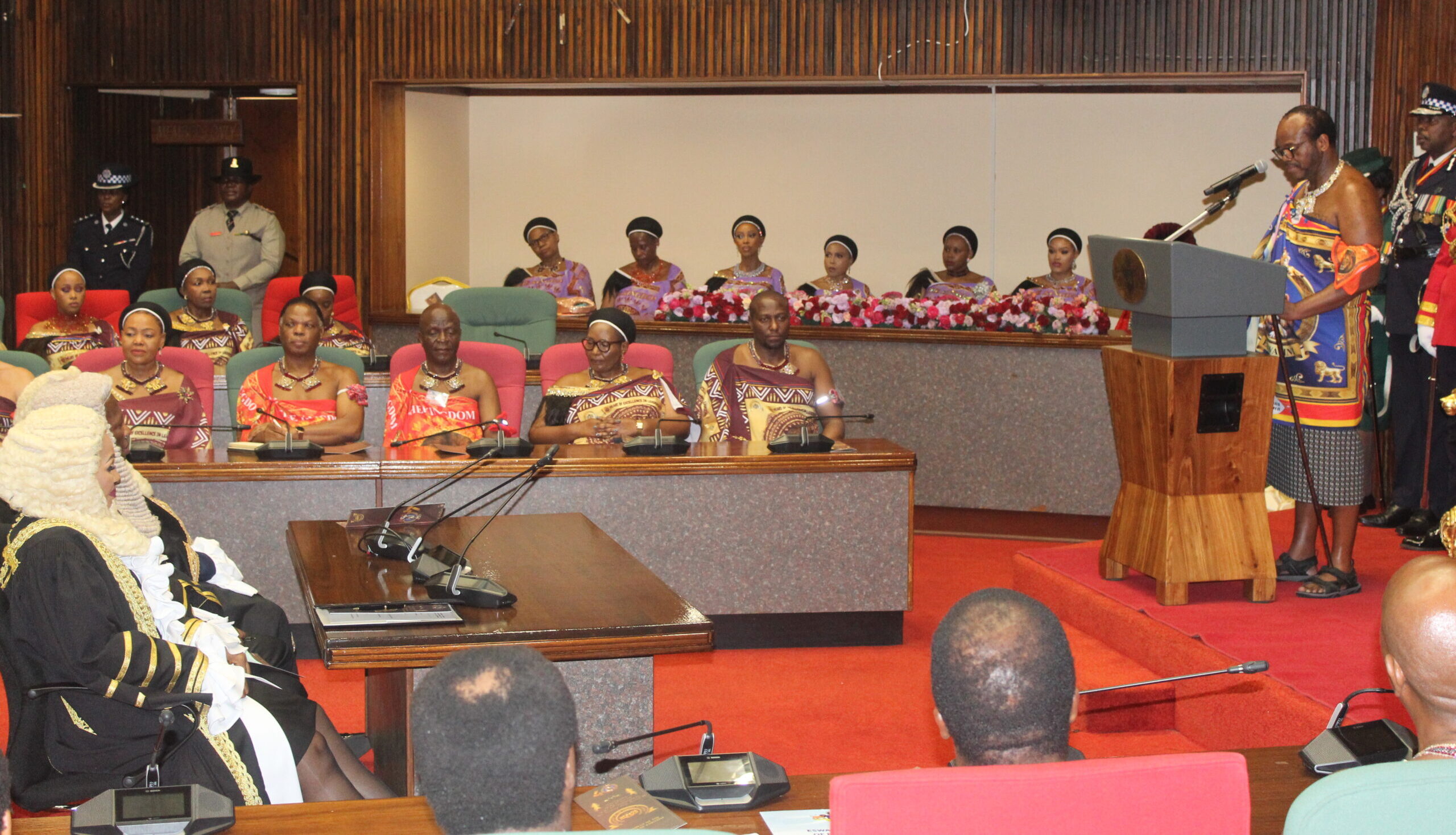
In a reflective address marking four decades on the throne, Mswati III highlighted what he described as the profound transformation of Eswatini’s economy since 1986.
Delivering the Speech from the Throne during the official opening of the Third Session of the 12th Parliament, the King noted that in 1986, Gross Domestic Product (GDP) stood at E1.4 billion.
By 2026, GDP is projected to reach E95.2 billion — representing a nominal increase of approximately 6 700 percent over 40 years.
While part of the surge reflects inflation and structural changes in the economy, the increase symbolises Eswatini’s transition from a largely agrarian, post-colonial state into a modernising middle-income economy.
The King said the economy has demonstrated resilience despite facing multiple global and regional shocks in recent years.
“This has been driven largely by the construction sector through major projects and various private-sector expansion initiatives,” he said.
He added that the outlook remains cautiously optimistic, supported by ongoing public and private investment in key projects.
“Growth is expected to be supported by ongoing public and private investment in key projects,” he declared.
A centrepiece of the 2026 economic agenda is an ambitious plan to raise GDP per capita from the current E78 238 to E480 000.
According to the King, the directive aims to elevate Eswatini into the ranks of high-income nations and deliver what he described as a “first-world experience” for citizens.
“We should not rest until our people get to realise much improved living standards,” he said.
To achieve this, the King called for the expansion of the country’s economic base and the strengthening of the financial sector.
“This requires us to build a highly resilient economic foundation by establishing a well-structured financial sector.”
Economist Sanele Sibiyane explained that GDP per capita is calculated by dividing a country’s total GDP by its population.
“GDP per capita is calculated by taking the country’s GDP and dividing it by the population,” he said.
He noted that if Eswatini’s GDP were distributed equally among citizens, each individual would receive approximately US$4 000 per year — roughly E64 274.
In 2023, Eswatini ranked among the top 10 African countries by GDP per capita, according to data compiled by Business Insider Africa using figures from Trading Economics, which tracks economic indicators across 196 nations.
While nominal GDP growth tells part of the story, economists caution that sustained growth, diversification, employment creation and income distribution will determine whether rising GDP translates into improved household living standards.
As the country marks 40 years under King Mswati III’s reign, the economic question shifts from growth alone to transformation — and whether ambitious per capita targets can be achieved in practice.