


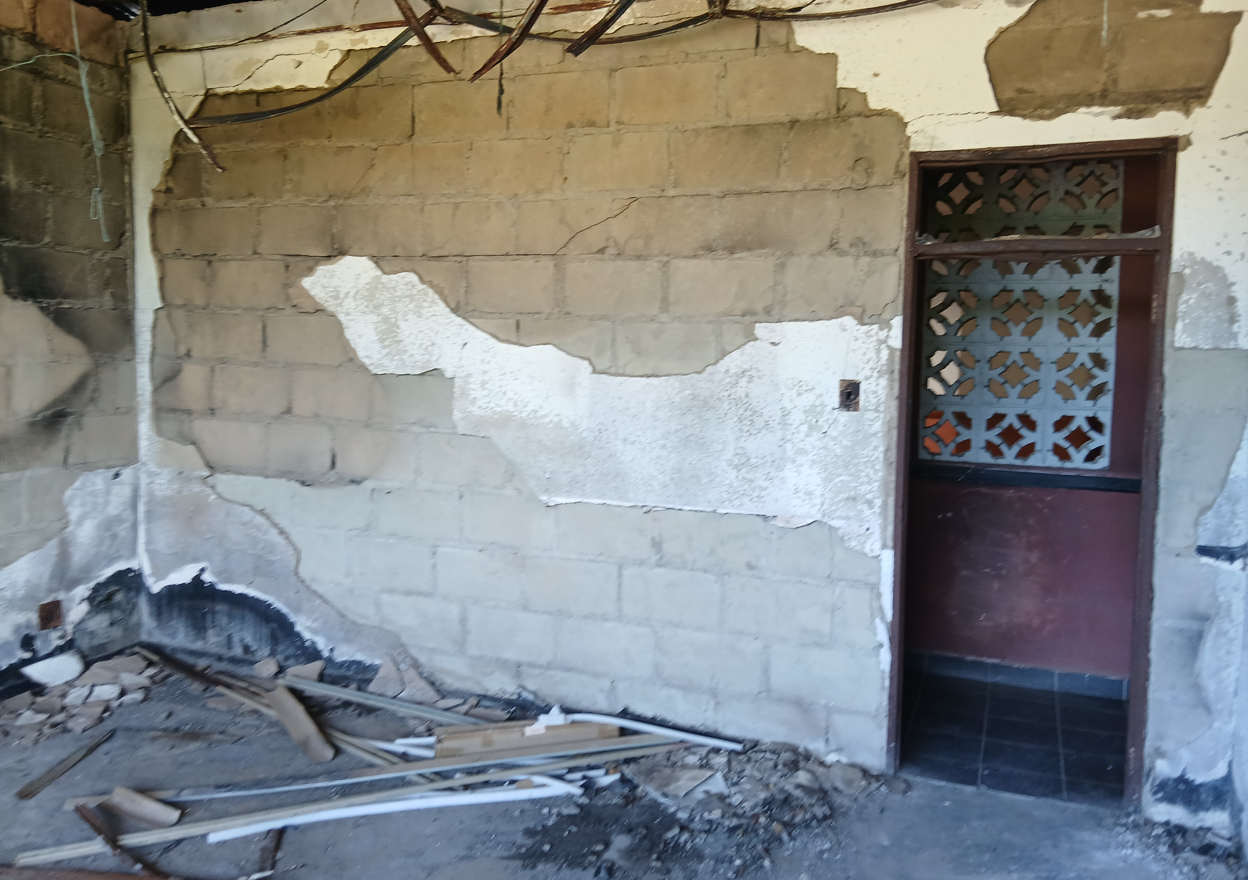
The Magistrate’s Court in Pigg’s Peak still bears the scars of the civil unrest that swept through the country in 2021.
Broken fittings, leaking roofs, damp offices and crumbling infrastructure have become part of daily life in a building meant to symbolise stability, justice and state authority.
For years, the deterioration has been explained as an unfortunate aftermath of unrest.
That narrative no longer holds.
While the unrest may have caused the initial damage, the failure to repair the court years later points to something far more serious — a pattern of administrative neglect, opaque spending and corruption that extends well beyond one building.
This is no longer a story about broken walls.
It is a story about broken governance.
From crisis damage to permanent decay
In the wake of the unrest, Pigg’s Peak Magistrate’s Court suffered extensive structural damage. Sections of roofing were compromised, exposing offices and archives to rain. Windows and internal fixtures were destroyed, leaving key areas vulnerable to moisture and deterioration.
In any accountable system, this would have triggered swift action: damage assessments, emergency repairs and funded rehabilitation programmes.
Instead, temporary destruction hardened into permanent neglect.
Years later, rain still seeps into offices during storms. Walls remain damp. Electrical systems show signs of deterioration. Filing rooms housing sensitive legal records are unsafe.
What should have been a short-term recovery became a long-term institutional failure.
Corruption doesn’t always look like theft
Public corruption is often imagined as money being stolen outright. In reality, it frequently operates through quieter mechanisms — endless delays, unimplemented budgets, vanished projects and responsibility shuffled between departments.
At Pigg’s Peak Magistrate’s Court, the central questions are no longer about what caused the damage, but about what happened afterwards:
-
Where were the post-unrest rehabilitation funds?
-
Which department was tasked with restoring the court?
-
Were contractors appointed, and if so, to do what?
-
Why has no one been held accountable for years of inaction?
When public institutions remain visibly damaged long after recovery funds should have been spent, the explanation cannot simply be inconvenience or bureaucracy. It demands scrutiny.
A workplace that endangers those who uphold the law
Court officials in Pigg’s Peak now work in conditions that would fail basic safety standards in most workplaces.
Rainwater floods offices during storms. Damp surfaces create mould risks. Electrical infrastructure has been compromised by prolonged moisture exposure. Sanitation facilities continue to deteriorate.
These are not minor inconveniences.
They are health and safety hazards.
Forcing public servants to operate in such environments reflects a governance culture where service is demanded, but protection and dignity are neglected.
When records rot, accountability follows
Perhaps the most dangerous consequence of the court’s decay is its impact on legal records.
Case files stored in damp conditions face water damage, mould growth and gradual disintegration. In any justice system, records are the backbone of accountability.
When they are lost or compromised:
-
Trials are delayed
-
Appeals are weakened
-
Historical responsibility disappears
In systems already struggling with corruption, disappearing records are never neutral. They benefit those who thrive on delay, confusion and procedural breakdown.
Allowing court archives to deteriorate is not just negligence — it is an open door to impunity.
The silence that shields failure
To date, no transparent public explanation has been offered on:
-
What formal damage assessments were conducted
-
What rehabilitation funds were allocated
-
Which tenders were issued
-
Who was responsible for implementation
-
Why repairs were never completed
This silence is not accidental.
In corruption-prone systems, silence is how accountability is neutralised. It diffuses responsibility, exhausts public attention and allows failure to persist without consequence.
A court reduced to a soft target
Judicial infrastructure is uniquely vulnerable to neglect.
Courts do not generate revenue. Their officials rarely protest publicly. Professional duty keeps the system functioning even under unacceptable conditions.
As a result, court buildings become easy places to defer maintenance, redirect funds or quietly abandon projects.
The irony is painful: the institution meant to enforce accountability is itself decaying because accountability has collapsed.
One court, one pattern, one national problem
What is happening in Pigg’s Peak is not unique.
Across the country, the same cycle repeats:
Damage occurs.
Emergency funding is announced.
Contracts are quietly awarded.
Budgets are spent on paper.
Projects stall, fail or vanish.
The results are familiar — roads that collapse every rainy season, bridges that weaken long before their lifespan ends, public buildings half-renovated and abandoned.
The court simply makes the crisis harder to ignore because justice itself operates inside the decay.
How tenders become engines of corruption
At the centre of this infrastructure breakdown lies a corrupted procurement process.
Contracts are frequently awarded to connected firms. Project costs balloon beyond market value. Cheap materials replace proper standards. Oversight disappears once funds are released.
In functional systems, infrastructure failure triggers audits and penalties.
In corrupted systems, failure triggers new tenders — fresh opportunities to extract public money.
Decay becomes profitable.
When law exists only on paper
Procurement frameworks are meant to guarantee fairness, transparency and value for money. In practice, they often collapse under political interference, manipulated bid specifications, recycled contractors and non-existent accountability.
Once oversight fails, corruption stops being an exception.
It becomes policy.
Justice undermined from its foundations
The most dangerous irony remains: the Pigg’s Peak Magistrate’s Court, meant to prosecute fraud, corruption and abuse of office, is itself a casualty of the same corrupt system.
As the court decays, efficiency drops, records deteriorate, morale collapses and public trust erodes.
Corruption thrives where justice is physically weakened.
This is not mismanagement — it is a system
Broken courts, failing roads, collapsing bridges and abandoned projects are not accidents of poor planning.
They are the predictable outcome of:
-
Manipulated tenders
-
Inflated contracts
-
Weak oversight
-
Political protection
-
Absence of consequences
Infrastructure is not designed to last. It is designed to cycle — repair after repair, tender after tender, budget after budget.
Each failure becomes the justification for the next extraction.
Questions that demand answers
The public deserves clear disclosure:
-
How much money was allocated to rehabilitate Pigg’s Peak Magistrate’s Court?
-
Which tenders were issued?
-
Who received them?
-
What work was certified as complete?
-
Why does the damage remain years later?
Transparency is not a favour. It is a public right.
Conclusion: Pigg’s Peak is evidence, not an exception
Civil unrest damaged the Magistrate’s Court in Pigg’s Peak.
What followed — years of inaction, silence and decay — reflects something deeper: a governance system where corruption thrives through neglect as much as through theft.
The same forces that keep the court broken keep roads collapsing, bridges failing and public money disappearing into endless “repairs”.
This is not coincidence.
It is structure.
Until procurement is transparent, audits enforced and accountability restored, the country will continue paying for infrastructure that never lasts — while watching its institutions crumble.
The broken court in Pigg’s Peak is not just a building in ruins.
It is a physical record of corruption in plain sight.