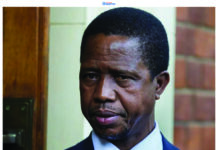


![Government Spokesperson Alpheous Nxumalo with Prime Minister Russell Mmiso Dlamini. [Courtesy pic]](https://eswatiniobserver.com/wp-content/uploads/2025/12/480955224_940003644989639_6961938701189516981_n.jpg "480955224_940003644989639_6961938701189516981_n")
Government’s attempt to resolve the salary dispute involving embattled spokesperson Alpheous Nxumalo through an out-of-court settlement has collapsed, with the matter now set to proceed to full legal argument at the Industrial Court next year.
The breakdown became apparent when the matter returned before Judge Abande Dlamini yesterday for the parties to present a written settlement agreement, as previously ordered.
Instead of finalising the deal, government indicated that while it was prepared to allow Nxumalo to report for duty, it was unwilling to pay outstanding salaries for the months he remained out of office.
Nxumalo had approached the court seeking an urgent order compelling the Civil Service Commission (CSC) and other government offices to release his salary, which he alleged had been unlawfully withheld since October.
He wanted payment for October and November, as well as any subsequent months, in line with his employment contract.
According to court papers, Nxumalo was appointed as a government public relations officer under a three-year fixed-term contract signed on September 15, and scheduled to commence on October 1.
He told the court that after signing the contract, he made himself available for duty, only to later discover that he had been placed under some form of suspension and prevented from assuming his post.
It was this exclusion from office, Nxumalo argued, that led to the withholding of his salary and ultimately forced him to seek the court’s intervention.
RELATED | Govt, Alpheous reach salary settlement, but…
When the matter came before the court yesterday, both parties confirmed that they had reached some form of understanding, but disagreed sharply on whether Nxumalo should be paid for the period he remained at home. This disagreement has now pushed the matter to full legal argument.
The court was informed that there was an agreement for Nxumalo to report for duty. However, when Judge Dlamini asked when exactly Nxumalo would resume work, there was no clear answer from government representatives.
“How does an employer not know when an employee is supposed to report for duty?” the judge asked, expressing concern at the apparent lack of clarity.
During the exchange, it emerged that Nxumalo could, in fact, report for duty immediately. The judge noted that Nxumalo had been at home for an extended period, a situation that now lies at the centre of the salary dispute.
The parties ultimately agreed that the matter would return to court on January 7, when arguments would be heard specifically on the issue of outstanding salaries.
Just last week, government had told the same court that it had reached a settlement to resolve the dispute.
That assurance was given by Henry Sibandze from the Attorney General’s office when the matter appeared before Judge Dlamini.
At the time, Sibandze informed the court that discussions were ongoing and that a settlement had been achieved, although he said some internal processes still needed to be finalised.
When pressed to disclose the terms of the settlement, Sibandze requested to brief the court in chambers.
Judge Dlamini rejected the request, noting that the matter was urgent and that any agreement should be placed on record in open court.
The judge granted government additional time, directing that the parties return with a signed agreement by Tuesday, failing which the matter would proceed to argument.
Nxumalo’s lawyer, Khumbulani Msibi, informed the court that his client had been promised payment when civil servants received their December salaries.
Sibandze declined to address the issue, insisting that the court should not entertain it.
The exchange drew a rebuke from the bench after Sibandze remarked that government was “ready for anything.” Judge Dlamini expressed dissatisfaction with the conduct, stating that government was not negotiating in good faith. The matter was then postponed.
Nxumalo earns a basic salary of over E650 000 per annum and is employed as a public relations officer based in the prime minister’s office.
In his application, he seeks an order directing the principal secretary in the prime minister’s office, the CSC chairperson, the accountant general and the attorney general to immediately process and pay his outstanding salary.
He is also seeking a declaration that withholding his salary amounted to a wrongful breach of his employment contract and has asked that the respondents be ordered to pay legal costs on the attorney-and-own-client scale.
Nxumalo argued that the Industrial Court has jurisdiction in terms of Section 8 of the Industrial Relations Act of 2000, as the dispute arises from an employer-employee relationship.
Nxumalo submitted that with the salary withheld he was literally living below the basic one dollar (E18) per day yet he has a valid contract of employment in force.
The matter will be back in court on January 7.