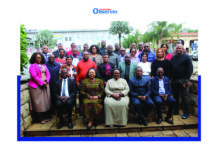



As the Kingdom commemorates 40 years of the reign of King Mswati III, the nation reflects not merely on longevity, but on consistency, fortitude and principled stewardship.
President of the Chartered Governance Institute of Southern Africa (Eswatini Chapter), Sandile Mbhamali, said the 2026 Speech from the Throne during the Third Session of the 12th Parliament reaffirmed a governance philosophy rooted in faith, stability and long-term economic vision.
“The King’s Speech is a reminder that governance is not about short-term gains, but about building institutions that endure,” he said.
Throughout history, societies have experimented with tribal confederations, monarchies, empires, oligarchies, republics, socialist states and constitutional democracies. Many rose with promise but declined through instability or fragmentation.
Mbhamali said the governance system that has endured across millennia is kingdom governance — a model founded on moral authority, continuity and covenantal accountability before God and the people.
He described the Tinkhundla system as a uniquely African expression of this enduring model, blending tradition with constitutional order while ensuring governance remains culturally authentic and institutionally stable.
ALSO READ | GDP SURGES BY 6 700% SINCE 1986
He noted that the speech highlighted the country’s economic transformation — from a GDP of approximately E1.4 billion in 1986 to E95.2 billion today.
Life expectancy has improved, infrastructure expanded through highways, dams and strategic national assets, while social welfare systems now support vulnerable citizens and strengthen social cohesion.
“These achievements are not accidental. They are the result of consistent leadership and a vision that places people at the centre of development,” Mbhamali said.
Mbhamali said the King’s call to diversify the economy beyond Southern African Customs Union (SACU) receipts and taxation reflected strategic fiscal prudence.
The emphasis on building a resilient financial sector and broadening revenue streams demonstrated forward-thinking stewardship.
“Diversification is the hallmark of sustainability. By reducing reliance on external receipts, the country is positioning itself for resilience in the face of global economic shifts,” he said.
He added that continued efforts to attract foreign direct investment through industrial parks, factory shells and the International Convention Centre reinforced investor confidence.
“Investors seek environments where rules are predictable and leadership is steady. The Kingdom offers precisely that — a governance model that inspires confidence,” he said.
The Strategic Oil Reserve, renewable energy expansion and the target of generating 50% of electricity domestically by 2030 were cited as indicators of long-term planning.
Digital transformation initiatives, including the broadcasting of parliamentary proceedings, were also highlighted as strengthening transparency and governance accountability.
“Transparency is the lifeblood of governance. By opening parliamentary proceedings to the public, His Majesty has strengthened accountability and deepened trust between the State and its citizens,” Mbhamali said.
He emphasised that corporate governance principles require ethical leadership, institutional discipline and stakeholder inclusion.
ALSO READ | US GOVT RALLIES AMERICAN COMPANIES TO INVEST IN ESWATINI
The speech’s focus on youth empowerment, education reform, healthcare strengthening and social protection demonstrated recognition of human capital as the foundation of economic success.
“Human capital is the true wealth of any nation. By investing in youth, education and healthcare, Eswatini is laying the foundation for prosperity that will endure for generations,” he said.
Mbhamali acknowledged that refinement was still necessary in capital project execution and industrial beneficiation, but maintained that the national foundation remained strong.
He said four decades of consistent leadership had delivered peace, infrastructure development, institutional stability and growing investor confidence.
“In a world where many governance systems face instability, the country’s Kingdom governance model continues to demonstrate resilience and relevance,” he said.
He extended heartfelt congratulations to King Mswati III for four decades of leadership, fortitude and commitment to economic sustainability and governance excellence.
“May the next 40 years strengthen institutions, deepen investor confidence and secure prosperity for generations to come. Long live the King. Long live the Kingdom of Eswatini.”