


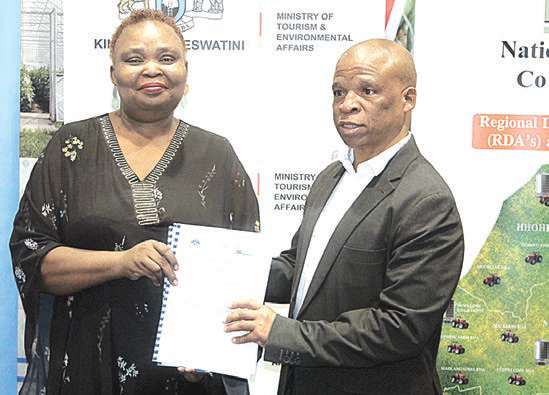
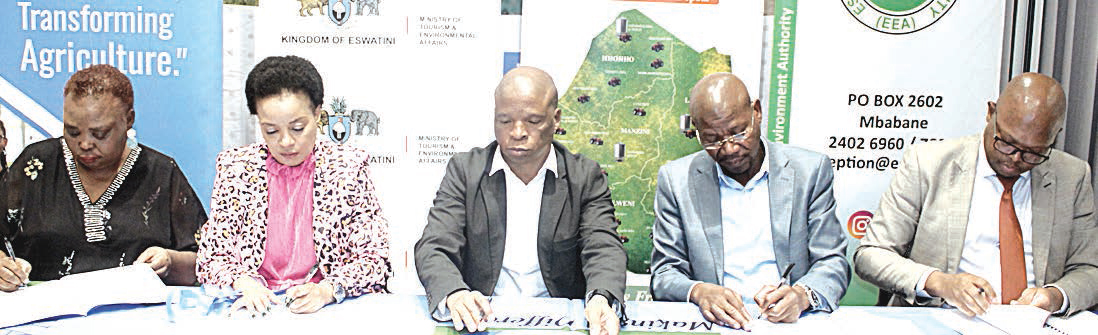
Eswatini Water and Agricultural Development Enterprise (EWADE) signed memorandums of understanding (MoUs) with different ministries and parastatals to improve the country’s food production.
The signing of the collaboration took place at the Hilton Garden Inn Mbabane yesterday. This was through the Smallholder Agricultural Productivity Enhancement and Marketing Project (SAPEMP), which is aimed at changing lives for Emaswati.
The four entities are the Ministry of Tinkhundla Administration and Development, Ministry of Tourism and Environmental Affairs, Eswatini Environment Authority (EEA), and the National Maize Corporation (NMC).
EWADE Chief Executive Officer Dr Samson Sithole said the landmark partnership formalised shared commitment towards collaboration, coordination, and impact. He noted that EWADE signed the first batch of MoUs with key strategic partners: Ministry of Agriculture, Deputy Prime Minister’s Office, and the National Agriculture Marketing Board (NAMBoard).
He said the partnership responded directly to the needs of smallholder farmers by ensuring alignment with institutional mandates, resources, and expertise.
“The signing of the MoUs moves our cooperation from good intentions to structured action, which speaks to our commitment to transparency, accountability, and results through collaboration and coordinated implementation. The MoUs signing today are not in isolation; they align directly to SAPEMP, providing the framework through which we will translate policy into coordinated action and ensure that the promise of this national programme is realised in tangible benefits for our farmers, communities, and the economy at large,” Dr Sithole said.
He noted that the challenges facing smallholder farmers’ productivity, market access, climate resilience, and knowledge gaps cannot be addressed in isolation. He said SAPEMP was designed to also promote and integrate multi-stakeholder solutions.
He said these partnerships responded directly to that need by aligning mandates, resources, and expertise. He also stated that another SAPEMP mandate is to increase smallholder farmers’ production, nutrition, and incomes, and to build their resilience to climate change through three components:
-
Production and productivity improvement of the target value chains
-
Improving market linkages and access to finance
-
Improved enabling environment for promotion of production and marketing of local produce
“SAPEMP aligns with Eswatini’s National Development Strategy, the Ministry of Agriculture’s strategic plan, and global commitments such as the Sustainable Development Goals (SDGs), particularly in areas related to poverty reduction, food security, and climate action. By leveraging public-private partnerships, SAPEMP is set to transform smallholder farming into a competitive, resilient, and market-driven sector, contributing to national food sovereignty, rural employment, and climate resilience,” added Dr Sithole.

The CEO also said the MoUs were national development instruments, a declaration of shared intent to empower smallholder farmers, strengthen value chains, and unlock the full potential of rural economies. He said they were also firmly aligned with the Eswatini Agriculture Sector Strategic Plan (2024–2028), National Development Strategy, and Vision 2050.
EWADE’s Role and SAPEMP’s Footprint
EWADE is proud to be the implementing agency of SAPEMP. The project, supported by government, International Fund for Agricultural Development (IFAD), and the Green Climate Fund, is designed to transform the lives of over 19,600 smallholder households, reaching nearly 117,700 people across all four regions.
Dr Samson Sithole said through SAPEMP, they have organised smallholder farmers into clusters to enable collective strength, rehabilitation, and construction of multi-purpose collection centres, ensuring aggregation, grading, and storage facilities that connect farmers to structured markets.
He said they have integrated farmers into digital platforms such as the Agricultural Integrated Information System (AIIS), ensuring real-time access to market intelligence, extension support, and pricing trends.
“We have been facilitating contracts between farmers and markets, ensuring secure markets for produce and promoting commercial farming. This is not just about improving production; it is about building resilience, raising incomes, and transforming communities. We aim to tackle the underlying causes of food insecurity and malnutrition through a package of interventions designed to build capacity on nutrition, gender, and social inclusiveness at national and household levels. This will ensure inclusion of youth and women in all initiatives for access to productive assets and financial incentives,” said Dr Sithole.
Highlighting Key Achievements
Under SAPEMP, he mentioned community-based Integrated Natural Resource Management (INRM), climate-smart production and nutrition, improving market linkages and access in targeted value chains.
Through the MoUs, he said they sought to operationalise these partnerships and officially declare their commitment to work with the government ministries, parastatals, and departments.
“EWADE fully recognised a fundamental truth that no institution could achieve transformation alone. The future of agriculture lies in shared resources, coordinated action, and collective accountability. By joining forces, we created a holistic ecosystem that supports farmers from production to market. The partnerships reflect the best of collaborative governance, anchored in complementarity (not competition), where every institution contributes its unique strength towards a shared national vision. We must work together to commercialise smallholder agriculture and build resilient, market-driven farming systems,” Dr Sithole said.
He added that the task ahead was a national one; it required government, parastatals, development partners, the private sector, and most importantly, farmers to work hand in hand to deliver the mandate of the project.
“As we formalise these partnerships today, we are committed to accountability and transparency as we implement projects, empower farmers—particularly women and the youth in agricultural development, excellence in service delivery, ensuring that every farmer benefits tangibly from this project. Innovation, leveraging digital platforms, and climate-smart agriculture to future-proof Eswatini’s farming systems are also key. The signing of these MoUs must not end as a symbolic gesture; it must mark the beginning of transformative action for the farmers that we represent today. Together, let us deliver tangible results at farmer level, where our impact matters most, and strengthen coordination across institutions,” urged Dr Sithole.





![Cashless payments, EHB Chief Executive Officer Mduduzi Dlamini. [Illustrative Image]](https://eswatiniobserver.com/wp-content/uploads/2026/04/EHB-218x150.jpg "EHB to close cash offices as it shifts to digital payments")