


Parents of Emaswati pupils enrolled in South African schools are concerned over the actions of ‘Operation Dudula’ as it has recently intensified its focus on foreign nationals within that country’s education system.
On Monday, members of the group visited schools in Gauteng and are reportedly heading to KwaZulu-Natal, alleging that schools prioritised undocumented foreigners in their systems.
| Eswatini Observer WhatsApp Channel
Some locals, particularly those living close to the borderlines such as Matsamo, Lavumisa, Sicunusa, Gege and Ngwenya have enrolled their children in South African schools due to their affordability and proximity. The children often use informal crossings to access the neighbouring country.
Zamekile Simelane from Gege said her daughter, who enrolled in Form I at a South African school, crossed the border daily through an informal route since it was permitted.
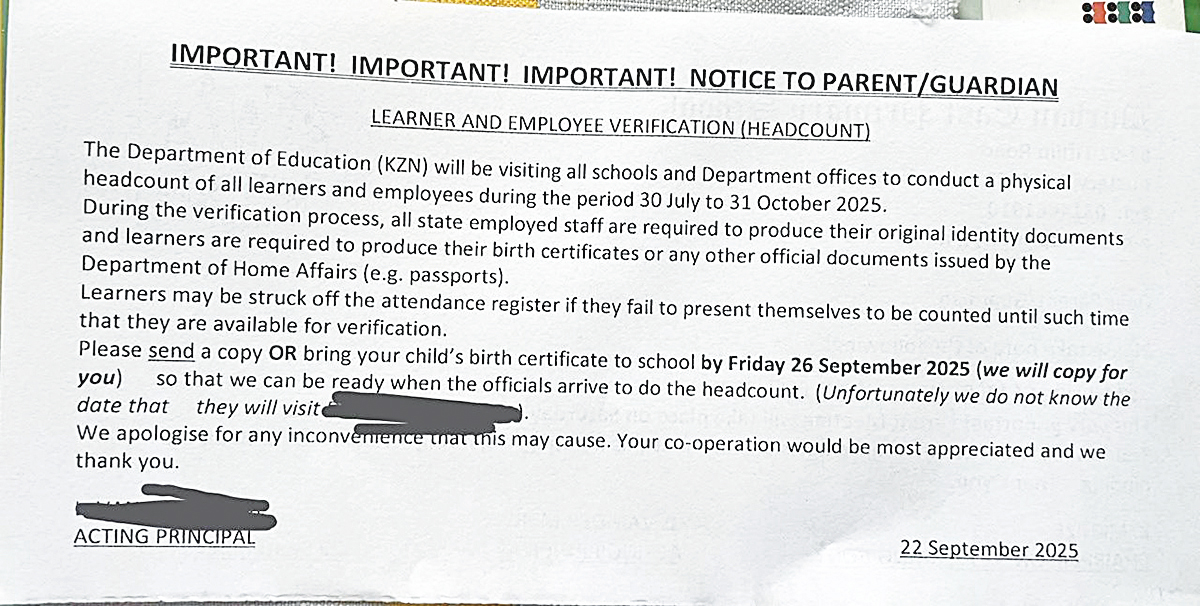
Worried, she claimed that her child recently returned home with a letter stating that she must produce a birth certificate or another official document, such as an identity card issued by the ministry of home affairs in South Africa for verification. Simelane alleged that the letter warned that learners could be struck off the school register if they failed to present themselves during a verification process. The process, according to the letter, began on July 30 and will run until October 31.
“Our children have been asked to submit their birth certificates, or copies, by Friday so that they will be ready when the officials conduct a headcount, though we do not know the exact date. We understand that this is spearheaded by the ‘operation Dudula’ that has been implemented in South Africa,” she claimed.
Another parent, Sipho Dlamini, said his daughter attended school at Hlabangemehlo Secondary in Nhlazatje, Mpumalanga.
He stated that no formal requests had been made to them yet, but acknowledged that parents were deeply concerned about the media reports detailing events in Gauteng.
“A Mozambican family in Soweto was affected, which is troubling given that the child had valid documentation. Education is a universal right, and every child should have access to it regardless of location,” he said.
Timphisini MP Thulani Nsingwane said many children cross informally into South Africa daily to attend school, mainly because of lower fees in his constituency.
“Learners in schools around Jeppes Reef pay only E200–E250 in fees. Many pupils in my constituency use informal crossings to attend Tinhlonhla High School and Schoemansdal Secondary School. Parents take advantage of the free education offered in South Africa, both in primary and high schools,” he said.
Gege MP Magesi Dlamini confirmed that the same practice was common in his constituency.
“There are many children enrolled in neighbouring schools since we are close to the border and education is free on the other side,” he said.
‘Operation Dudula’ is a splinter group from a faction in the ‘Put South Africans First’ movement, an organisation that first popularised and renewed anti-immigrant campaigns on social media before finding expression on the ground.
On Monday, ‘Operation Dudula’ leader Zandile Dabula, when speaking to SABC news, stated that they delivered warning letters to 11 schools in Soweto ahead of the next academic year. The movement has been blocking illegal foreigners from accessing healthcare services and was now urging township schools to prioritise South African learners over foreign nationals.
“We have been to four schools so far, and have a target of 11. We are glad that some schools admit that there are wrongs in their systems. Another issue is undocumented South Africans, who are not getting help from home affairs despite being given three months’ probation to get documented,” Dabula said.
The campaign began with visits to Lofentse High School for Girls in Orlando East, Soweto, and Noordgesig Primary School, among others, where ‘warning letters’ were delivered stating that no South African child should be deprived of education in favour of foreign nationals.
Provincial spokesperson for the Gauteng Department of Education, Steve Mabona, told IOL News that the province had a duty to provide education to all children, including those deemed undocumented or illegal.
“It is not unreasonable for anyone who is here illegally to be deported, but that is the work of home affairs. As a department, we cannot take part in their plan. However, we have a responsibility to work closely with law enforcement to ensure law and order in schools,” he said.
A government gazette published on February 10, 2021 reaffirms that, under Section 20 of the South African Schools Act, 1996, the right to education applied equally to non-citizens.
According to the policy, non-South African learners fall into two categories: those with temporary or permanent residence permits, or other special residence documents issued by home affairs; and those with asylum-seeker or refugee visas under the Refugees Act, 1998.
It further required foreign learners with permanent residence permits to submit a birth certificate from their country of origin, their residence certificate, or an identity document from their home country (for learners aged 16 and above), or a passport.
The gazette emphasises, however, that the right to education extends to everyone within South Africa’s borders, regardless of nationality or immigration status.
“All schools are advised to admit learners and serve their educational needs, irrespective of whether the learner or their parent produces the documents listed.”
Eswatini Observer Press Reader | View Here